

You finish reviewing your monthly numbers and see that the business turned a profit.
So why does it still feel like you’re watching every dollar?
It’s a frustrating situation that many business owners face. Your profit and loss statement says you’re making money, but your bank balance seems to be telling a different story.
It’s a question accountants hear all the time, especially from operators of growing businesses.
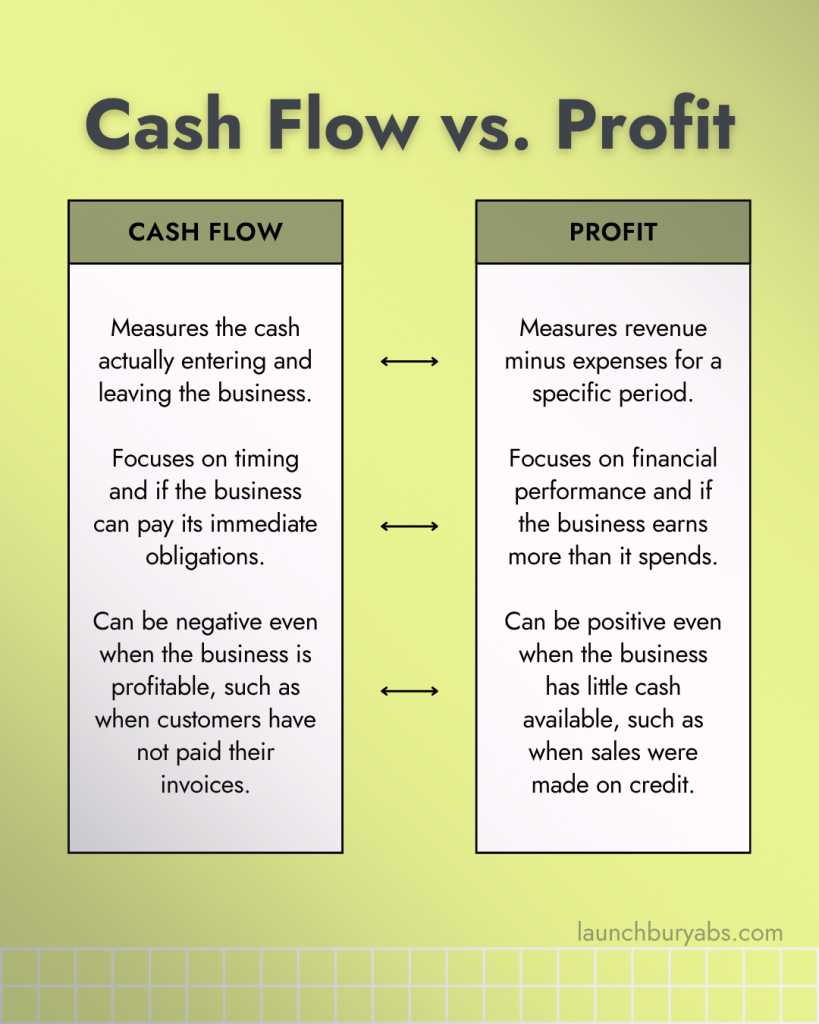
The reason is fairly simple. Profit and cash flow measure two different things.
Understanding cash flow vs. profit, and why the two numbers don’t always line up, can help you make much better sense of what’s happening with your money.
Cash Flow vs. Profit: What’s the Difference?
Profit Tells You Whether Your Business Is Making Money
Your profit, or what’s shown on your profit and loss (P&L) statement, measures whether your revenue exceeds your expenses over a specific period.
Let’s say your business invoices $50,000 in a month and records $40,000 in expenses. On paper, you’ve earned a $10,000 profit.
That’s good news. But it doesn’t necessarily mean you have an extra $10,000 sitting in your bank account.
Some of that $50,000 may be sitting in accounts receivable because customers haven’t paid their invoices yet. Or, you may have made loan payments or purchased equipment during the month.
This is where many business owners get tripped up. Your P&L can show that your business is profitable without telling you exactly how much cash you have available right now.
Cash Flow Shows What’s Happening With Your Cash
Cash flow tracks the movement of cash into and out of your business.
It helps answer practical questions like:
- How much cash is available to pay suppliers?
- Can payroll be covered this week?
- Is there enough money to invest in new equipment?
- Will upcoming expenses create a cash crunch?
A P&L statement tells you whether the business made money over a given period.
Cash flow tells you what happened to the cash during that time.
Why Cash Flow and Profit Don’t Always Match
So, where does the difference come from? There are several common reasons a profitable business can still feel short on cash.
Customers Haven’t Paid Yet
Getting paid and earning revenue aren’t always the same thing.
You can finish a project today and send the invoice immediately, but if your customer has 30- or 60-day payment terms, you may not see that money for weeks.
Depending on how your business accounts for revenue, that income may already appear on your P&L even though the cash hasn’t reached your bank account yet. That’s why a strong month for sales doesn’t always translate into a strong cash balance right away.
You’ve Purchased Inventory
Businesses that carry inventory often have to spend money well before they sell those products.
When you purchase inventory, the money may leave your bank account immediately. But your P&L generally records the cost of that inventory when you sell it.
If you’ve recently stocked up for a busy season or placed a large order, your cash balance may drop even though the purchase is intended to support future sales.
Loan Payments Affect Cash Differently Than Profit
Loan payments can also create a noticeable difference between profit and cash flow.
While the interest portion on a loan payment is recorded as an expense on your P&L, the principal portion is not.
That principle still comes out of your bank account. As a result, you can have a profitable month while also using a significant amount of cash to repay debt.
Equipment Purchases Reduce Cash Immediately
Buying new equipment, vehicles, or technology can strengthen your business for years to come, but those purchases also require a significant amount of cash upfront.
Depending on how you record the purchase, you may not report the full cost as an expense on your P&L that month. Instead, you may depreciate the asset over time.
Your bank account, however, feels the purchase immediately.
Cash Flow vs. Profit: Why The Difference Matters
When you’re comparing cash flow vs. profit, neither number gives you the full picture on its own.
A profitable month doesn’t automatically mean it’s the right time to hire, purchase equipment, pay down debt, or take on a major project. Likewise, having plenty of cash in the bank today doesn’t necessarily mean the business is profitable or financially stable.
The difference matters because you don’t make business decisions on paper alone. You need to know how the business is performing and whether you have enough cash to support what you want to do next.
How Good Bookkeeping Helps You Stay Ahead
Keeping your books up to date is especially important.
Up-to-date financial records can help you see:
- How much customers still owe you
- What bills and payments are coming up
- Where cash is being tied up
- Whether the business is generating enough cash to support planned spending
- If a cash shortage is temporary or may point to a bigger issue
That visibility becomes increasingly important as your business grows. If your books are weeks or months behind, you may be making today’s decisions based on an outdated picture of the business.
Current books give you better information to work from, whether you’re considering a new hire, planning a major purchase, managing debt, or preparing for your next stage of growth.
Make Sense of What Your Numbers Are Telling You
If your P&L says you’re profitable but your bank account seems to tell a different story, we can find an explanation in the numbers.
Launchbury Accounting & Bookkeeping Solutions works with businesses across Alberta and New Brunswick to keep their books current. We also help our clients understand their financial reports so they can use that information to better run their business.
Whether you need help catching up on your bookkeeping, improving your financial reporting, or getting a better handle on your numbers, we can help.